
Invisalign vs Braces: Which Option Is Better For Adults?
April 7, 2026
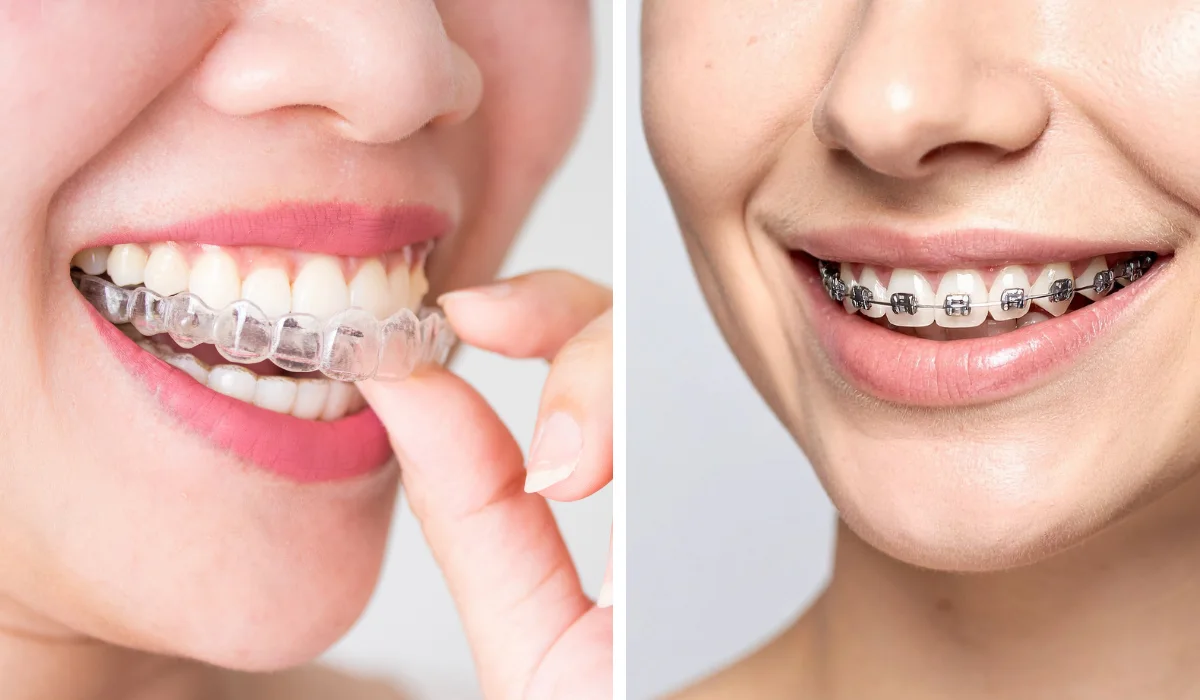
Table of Contents
Orthodontic treatment in Canada has come a long way, and today, both Invisalign and braces can deliver strong results for adults who want to correct misalignment, improve bite function, and feel more confident about their smile. In practice, both options show similar success rates.
That said, the better option does not come down to trend or preference. It comes down to the level of correction your teeth and bite actually need. Invisalign often works well for mild to moderate concerns, while braces may offer better control in moderate to severe cases.
Patient experience matters too. A 2018 study found that Invisalign patients reported a better experience with eating and chewing than those with traditional braces, which shows how small day to day differences can shape comfort during treatment.
Who Is Each Dental Treatment Typically Recommended For?
At Gleam Dental® , responsible orthodontic care starts with choosing the treatment that will create the best result for your teeth and long-term oral health. Before beginning treatment, our dentists assess each patient individually to determine which option will deliver the safest result.
We recommend traditional braces for:
- Moderate to severe misalignment, which needs mechanical control
- Significant bite issues such as overbite, underbite, or cross-bite
- Teeth that are severely rotated or require complex repositioning
- Patients do not want daily compliance that comes with Invisalign
- Cases that require elastics or additional orthodontic support
We recommend Invisalign for:
- Mild to moderate crowding or spacing between teeth
- Mild to moderate bite concertions
- Adults who want a more discreet treatment option
- Patients who can wear aligners for 20 to 22 hours a day
- Patients who want fewer changes to eating and oral hygiene habits
4 Differences Between Invisalign and Traditional Braces:
1. Treatment Process
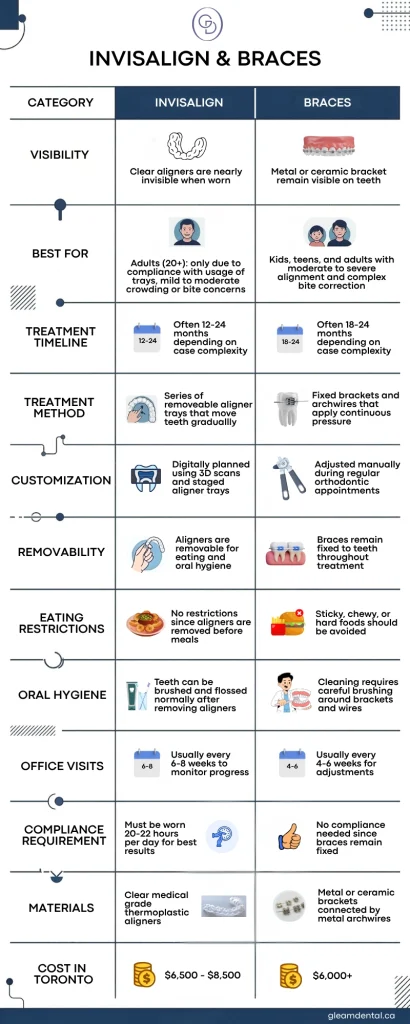
Both Invisalign and braces straighten teeth by applying controlled pressure over time to move teeth into a better alignment. Invisalign uses a series of custom made trays that guide tooth movement in stages, while braces use fixed hardware that stays on the teeth throughout treatment.
Invisalign
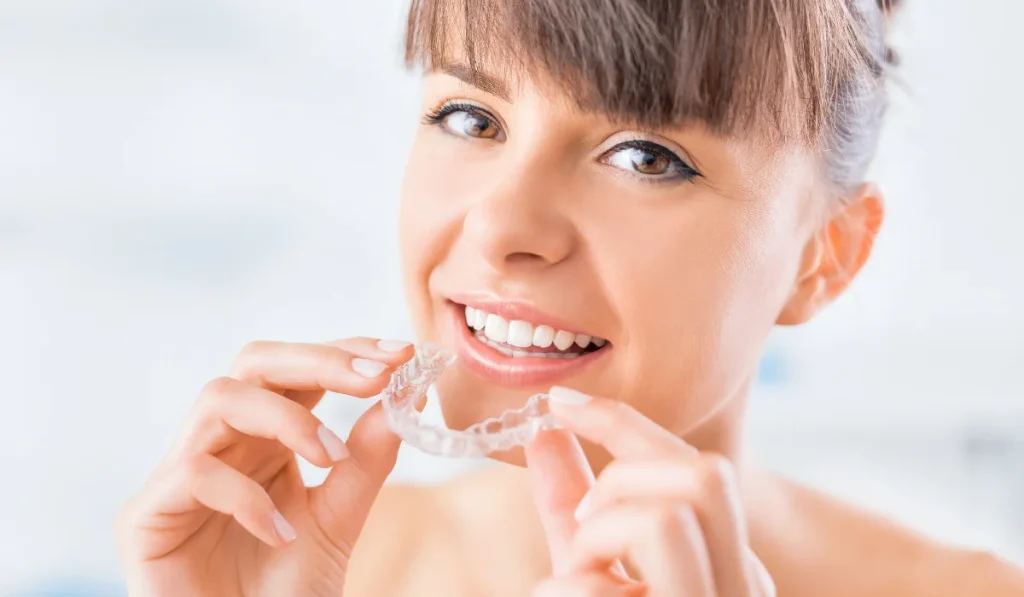
Invisalign uses a sequence of clear, custom aligners/trays that fit closely over the teeth and are removable by the patient. Each set is designed to make small, planned movements before the next tray takes over.
It is a digitally planned treatment, which gives dentists a clear view of how the teeth are expected to move over time. Small tooth-coloured attachments are temporarily placed on the teeth and are used to support precise and gradual tooth movement.
- Patients usually wear each aligner set for 1 to 2 weeks before switching to the next aligner set
- Aligners need to be worn for 20 to 22 hours a day to keep treatment on track
Braces
Braces use brackets fixed to the teeth and connected by wires that apply steady pressure over time. As treatment progresses, the dentist adjusts the wires and other components to continue guiding tooth movement.
In some treatment plans, elastics or other orthodontic appliances are also used to support bite correction.
2. Treatment Timeline
In moderate cases, Invisalign and braces often take a similar amount of time, usually around 18 to 24 months.
Invisalign
A minimum of about 20 trays is often recommended for most adult cases, which are changed every 1-2 weeks. More complex cases may require 30 to 40 trays or additional refinement trays.
Braces
As the teeth begin to shift, your dentist periodically adjusts the system to continue guiding movement and maintain steady pressure.
Adjustments are usually scheduled every 4 to 8 weeks. During an adjustment, the dentist may tighten or replace the arch-wire, change elastics, or reposition certain components
3. Materials and Manufacturing
Invisalign is produced using digital planning and precision manufacturing, while braces rely on durable orthodontic materials that have been used successfully for decades.
Invisalign
Aligners are made from clear medical grade SmartTrack® thermoplastic and each tray is custom manufactured using digital scans and 3D treatment planning.
Braces
Braces use brackets that are bonded to the teeth and connected by an archwire. They can be metal or ceramic. Patients choose ceramic options for a less noticeable look.
The archwire itself is still metal, although some offer tooth-coloured coated options. Since the appliance stays attached throughout treatment, patients must avoid consuming sticky or hard foods.
4. Daily Care and Oral Hygiene
Both dental treatment options demand consistent oral hygiene to prevent plaque buildup.
Invisalign
Aligners are removable, which allows patients to brush and floss their teeth normally.
- Aligners are removed before eating or drinking anything other than water
- Teeth should be brushed before placing the aligners back in the mouth
Braces
Food particles can easily become trapped, so brushing and flossing require extra attention.
- Brushing must be done carefully around brackets and wires
- Flossing may require floss threaders or water flossers
- Patients must avoid certain foods
Premier Cosmetic Dental Clinic in Toronto
Located in Toronto’s west end, Gleam Dental is a boutique dental clinic focused on cosmetic dentistry and modern orthodontic care. Founded by Dr. Lidiya Zavalishina, we are a dedicated team of compassionate dentists, hygienists, and assistants who believe dental care should feel personal, polished, and comfortable.
Our dentists begin every Invisalign or braces treatment with a detailed consultation and digital scan to evaluate tooth alignment, bite pattern, and treatment goals. From there, we recommend the option that will deliver the most stable, functional, and aesthetically-balanced result.
We continue to invest in advanced orthodontic technology, modern techniques, and ongoing clinical education to bring more accessible dental care for patients across Toronto.
Book a consultation today to learn more.
Commonly Asked Questions About Invisalign and Braces
Is Invisalign more expensive than traditional braces?
In many cases, Invisalign and braces cost a similar amount. Invisalign treatment in Toronto often ranges between $6,500 and $8,500, while braces typically start around $6,000 or more, depending on treatment length and complexity.
Does Gleam Dental offer financing options for Invisalign or braces in Toronto
Yes, we do offer payment plans. Please reach out to our team to learn more.
Who don’t you recommend Invisalign for?
Invisalign may not be the best option for patients with severe bite issues, significant tooth rotation, or complex jaw alignment concerns. It also requires a greater degree of compliance as trays must be worn 20–22 hours per day for best results.
How often do I need to visit the dentist with Invisalign or braces?
With Invisalign, patients usually visit the dentist every 6 to 8 weeks so progress can be monitored and new aligner sets can be issued if needed. Braces typically require more frequent adjustments, often every 4 to 6 weeks, because the dentist must tighten wires or modify components to continue guiding tooth movement.
How much do braces and Invisalign cost in Toronto?
At Gleam Dental, Invisalign treatment typically ranges from $6,500 to $8,500 depending on the complexity of the case. Braces generally start around $6,000, with treatment often lasting a year or longer. The final price depends on the treatment plan you need to get desired results.
Are any cosmetic dental treatments covered by insurance in Canada?
Many private dental insurance policies offer partial orthodontic coverage for treatments such as braces or Invisalign, usually with a lifetime orthodontic limit. The Canadian Dental Care Plan (CDCP) focuses mainly on essential oral health services and typically does not cover cosmetic orthodontic treatments for adults.